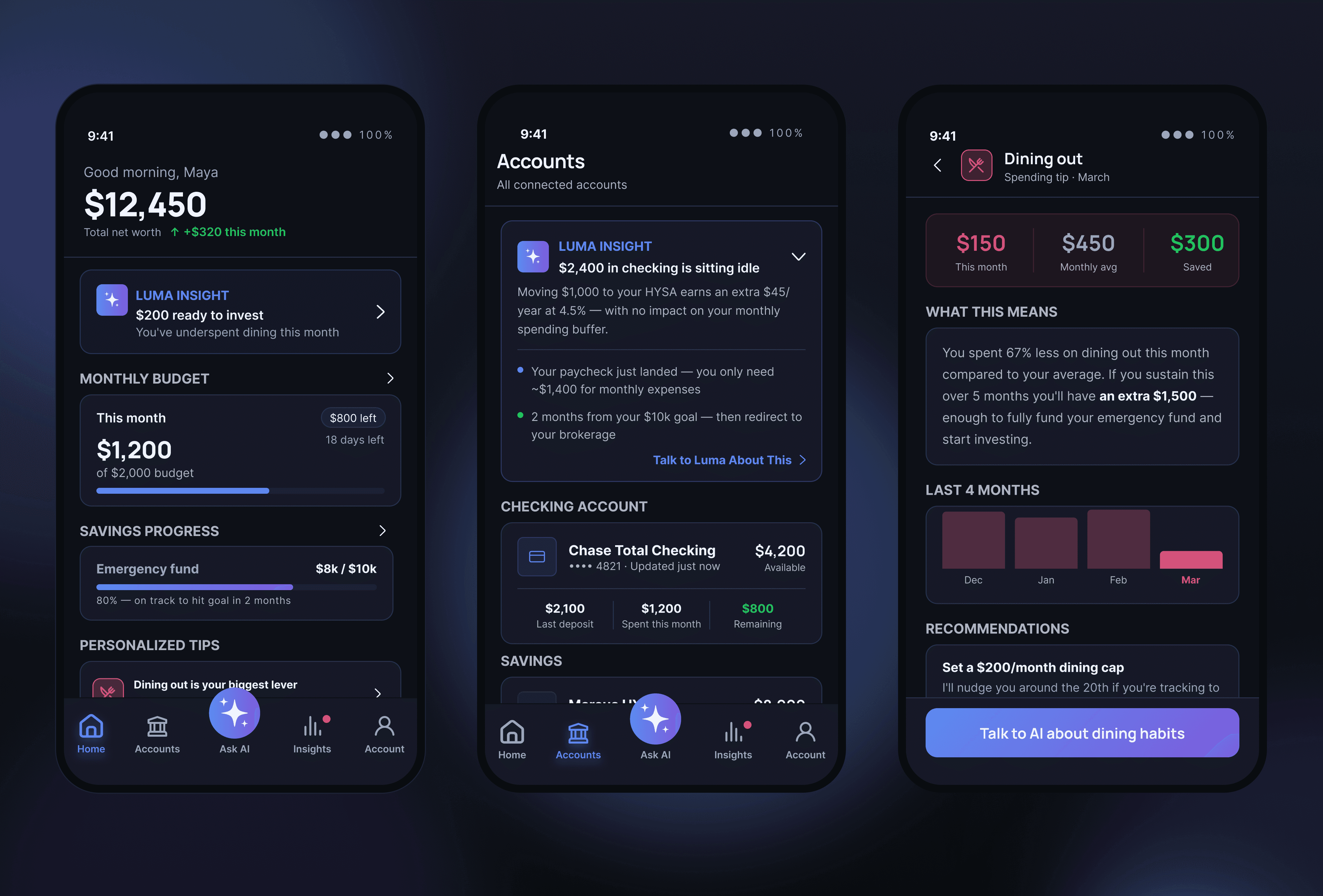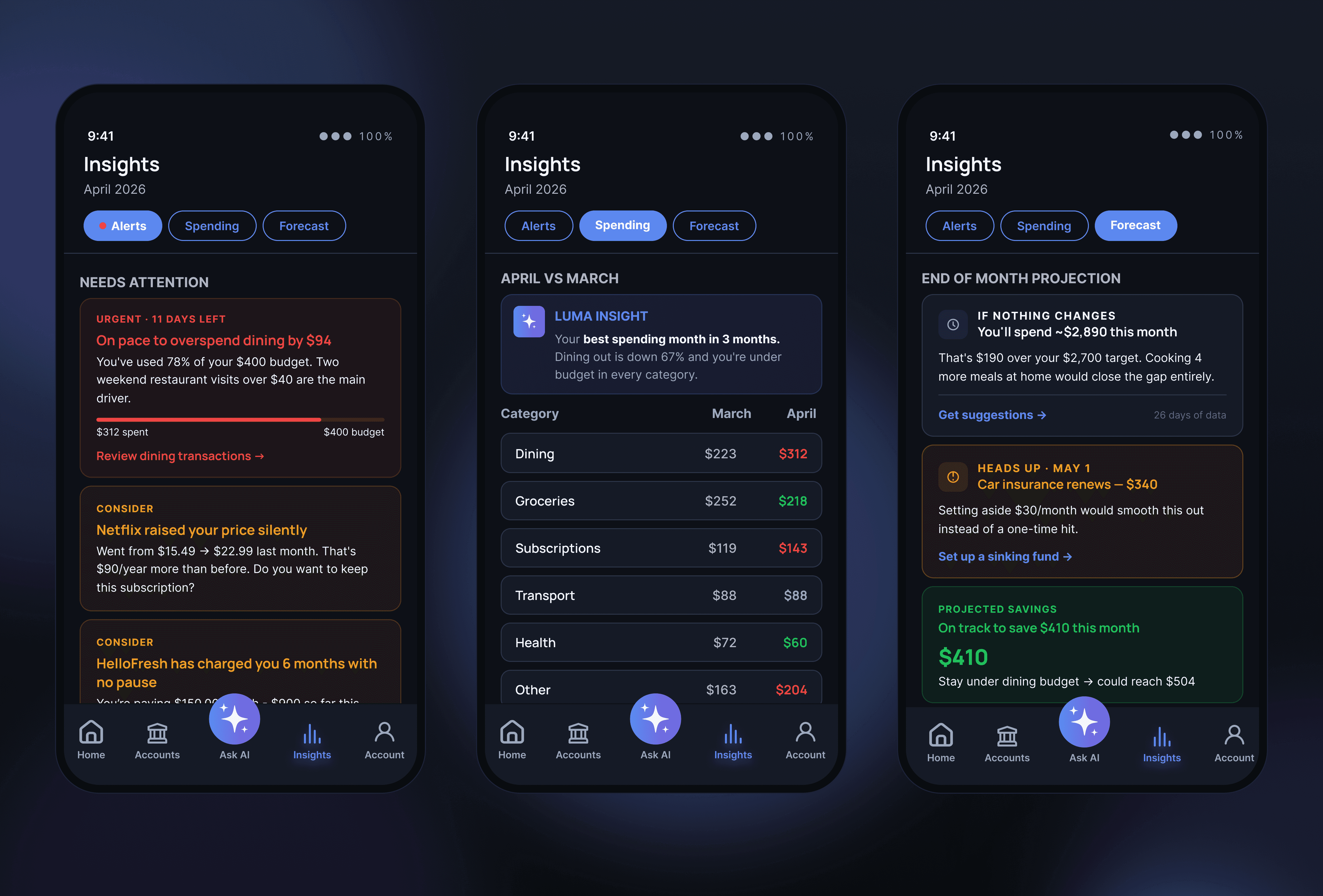
Designing an AI finance assistant that moves young professionals from anxiety to confident, actionable decisions.
Industry
Fintech
My Role
Digital Product Design
Duration
3 months


CONTRIBUTIONS
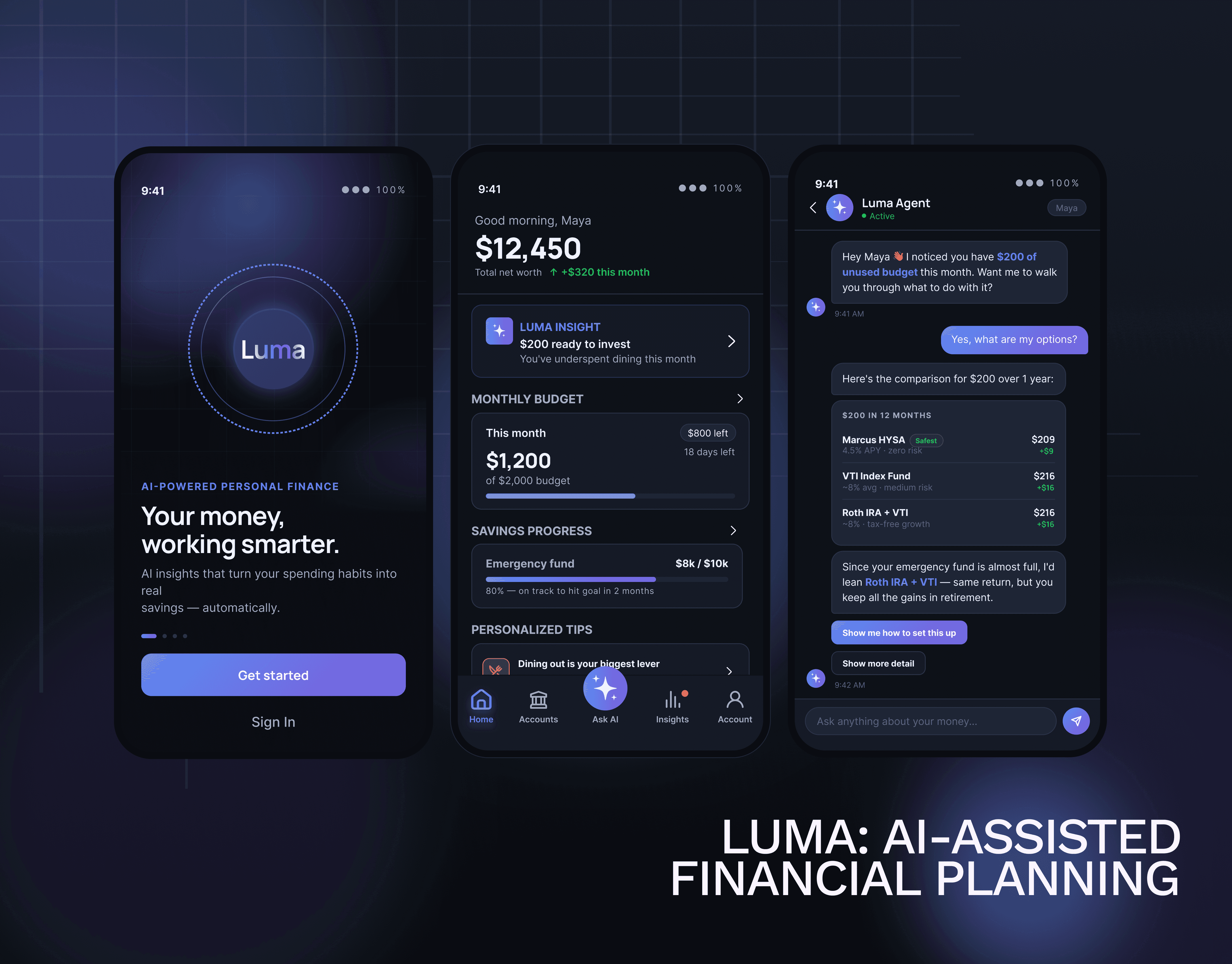
Designed a full AI-powered finance app end-to-end: research, personas, prototyping, and usability testing, all using AI tools to compress a multi-month process into weeks
Identified and resolved ethical tensions in AI-driven UX, repositioning the assistant as an advisor rather than an actor to build user trust
Developed a hybrid human-AI workflow in Figma via MCP, then applied independent design judgment to fix what AI couldn't such as accessibility gaps, usability failures, and visual nuance
People don't need more financial data, they need to know what to do with it
Existing finance apps like Monarch, YNAB, and Copilot compete on tracking and visualization. None address the deeper issue: motivated young professionals are stalled by decision paralysis, unclear starting points, and tools that surface numbers without context or guidance.
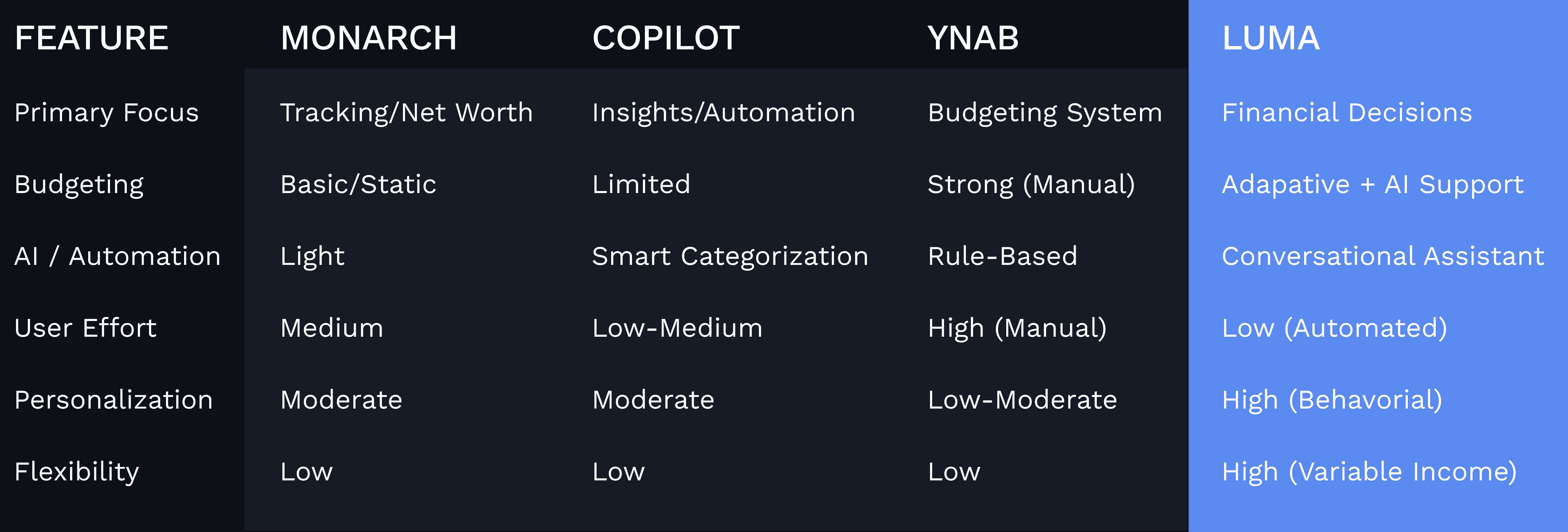
AI-Assisted Competitive Analysis
Claude and ChatGPT were used to rapidly synthesize competitive research across leading financial tools, helping identify common patterns, feature gaps, and opportunities for differentiation.
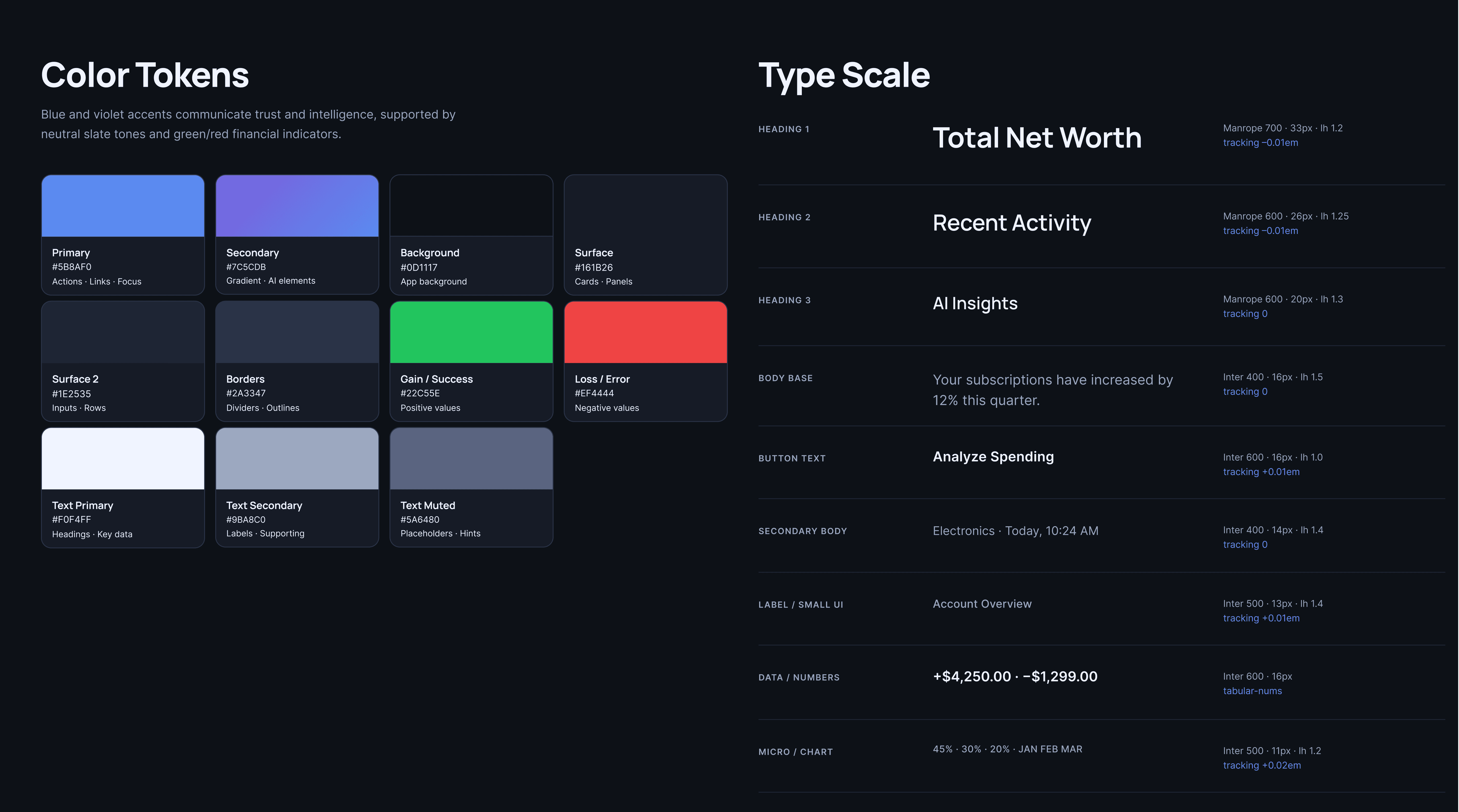
Building a Scalable Design System with AI
Using research insights and AI-assisted workflows, we developed a cohesive design system that established consistency across the product experience. Claude helped accelerate the creation of foundational elements including color tokens, typography scales, radius variables, icons, and reusable components, allowing the team to move faster while maintaining a polished and accessible interface.
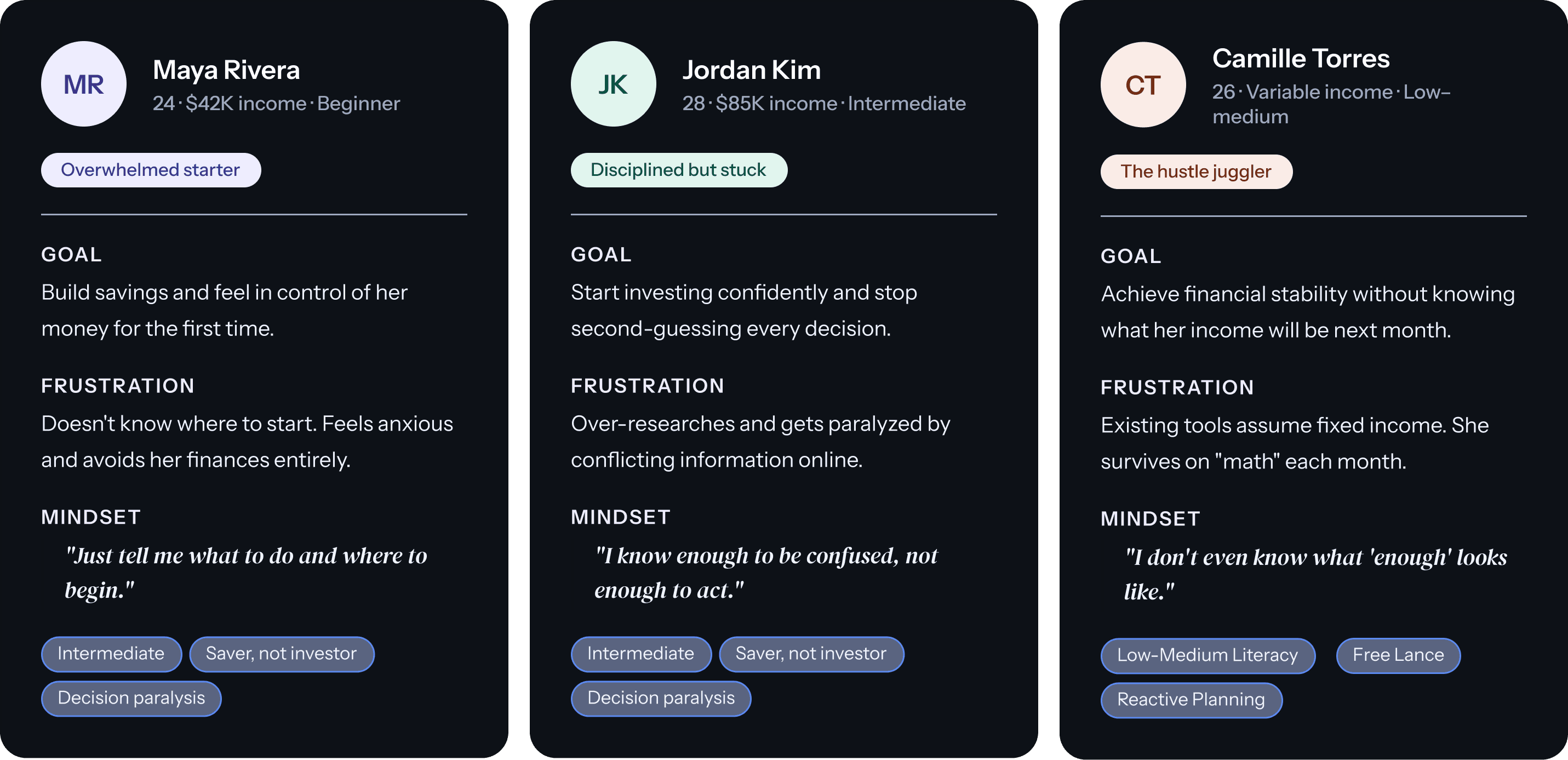
Three personas, one shared need: a trusted guide
Using AI-assisted synthesis, alongside qualitative methods, I built proto-personas spanning a range of financial confidence, income stability, and emotional relationship with money.
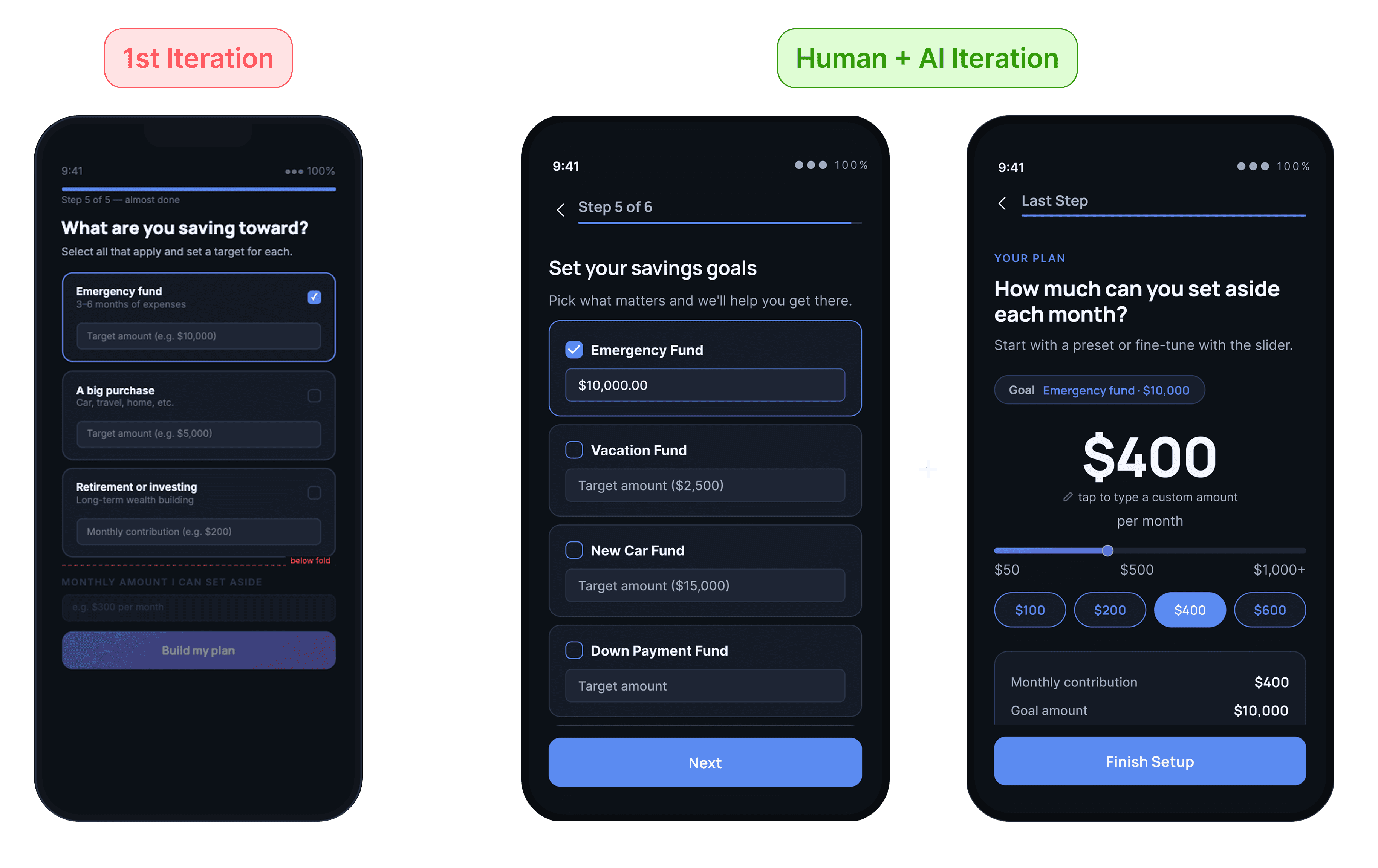
AI-Accelerated Iteration, Human-Guided Usability
After identifying key usability pain points through user testing, both AI-assisted and human testing, Claude was used to rapidly explore and iterate on potential solutions. While AI helped speed up ideation and adjustments, human intervention was critical to refine interactions and ensure the final designs met usability standards.
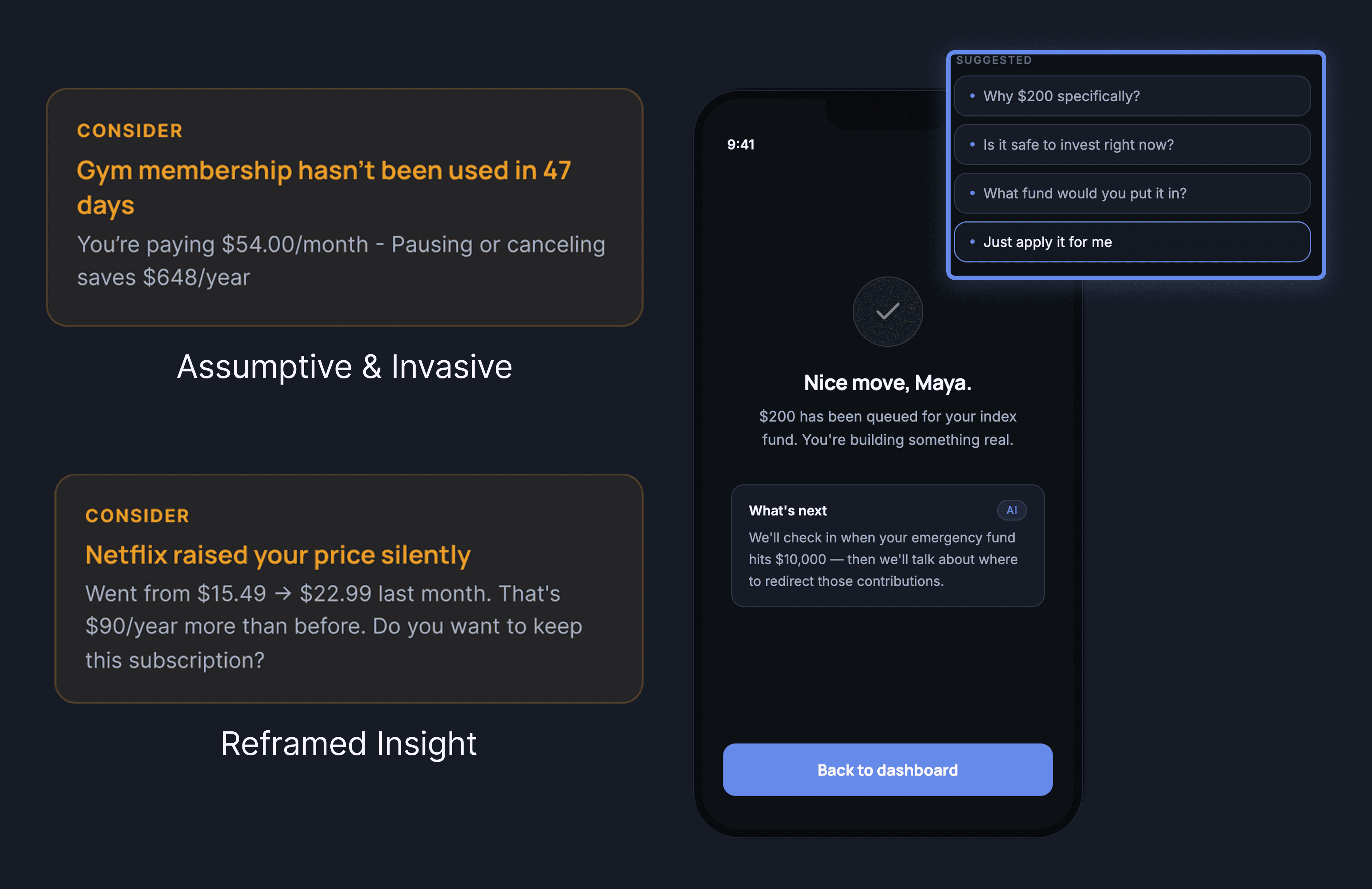
Designing for trust, not just utility
Testing revealed a critical tension: 4 out of 5 participants were uncomfortable with AI making financial decisions on their behalf, but open to AI that explains and suggests. This reframed the entire design. Insights shifted from behavioral judgments to verifiable facts, and every AI action requires explicit user approval before executing. The AI earns trust by informing, not assuming.
OUTCOME
AI accelerated the entire UX/UI workflow, enabling rapid generation of wireframes, design systems, personas, and prototypes that would typically take weeks to produce. This speed allowed for broader exploration early in the process, but also surfaced the need for strong human oversight to ensure outputs were usable, accessible, and ethically sound.
The final experience prioritizes trust, consent, and user control, ensuring financial insights remain relevant and non-invasive while avoiding autonomous financial actions. AI serves strictly as an advisor, with all decisions and interactions intentionally designed to remain transparent, user-driven, and aligned with real user needs.